
9. X-Pigeons |
||||
In this page, I would like to discuss the basic facts about pigeons, their intelligence and social behavior, their ancestors, and their interaction with humans, before moving on to the evolution and the natural selection. Although many of you might be familiar with the basic pigeon facts and their impressive intelligence, I thought it would be helpful to understand their interaction with humans throughout history. Over thousands of years, pigeon breeders allowed only the birds with desirable characteristics to reproduce, causing the evolution of their domestic stock. This process is called artificial selection because people (instead of nature) select which organisms get to reproduce. Selective breeding can be unintentional, e.g., resulting from the process of human cultivation; and it may also produce unintended – desirable or undesirable – results. We know Homing pigeons act and behave no matter where we keep them in the world. Therefore, we cannot say that their behavior is influenced by the environment. They were born with that behavioral instinct to find home. The genes control the physical and behavioral differences for the different pigeon breeds. What genes make the Homing pigeons home from miles away and what genes cause rollers to roll is still unknown. Understanding these different behaviors found in different breeds might help us understand why they were purposely selected for their behavior by humans. By sorting out the genetics of different pigeon breeds’ behavior and personality differences, we will gain a lot of insight into how genes control both.
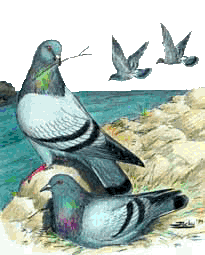 From
bill to tail, the average pigeon is about 13 inches. Males are normally
bigger than
females. The average pigeon weighs a little less than a pound. Pigeons
were born to be "prey" animals and therefore are hunted
and killed by a great number of predators. Pigeons are generally
defenseless animals and other than speed of flight, stand little
chance against their hunters. Main predators of pigeons are hawks,
owls, peregrine falcons, cats, raccoons, possums, weasels and snakes.
Studies show that the lifespan of a feral pigeon is only to 3 to
5 years in the “wild”. With proper feed and care, pigeons
can live 15 years or more in captivity. The oldest recorded pigeon
was around 33 years old. Pigeons reach sexual maturity at 4 to 6
months. They are socially monogamous, but extra-pair matings do occur,
often initiated by males. They usually build flimsy nests using sticks
and twigs they collect from their environment. The average clutch
consists
of two white eggs, which are incubated for about 18 to 19 days by
both parents. The parents take turns keeping their eggs warm (incubating).
Incubation is not equally shared, since the hen does most of the
work on each day. Only when she leaves the nest, the cock assumes
the duties. The parents
need to keep a steady temperature
of about 102-105
degrees F 24 hours per day for the embryo to properly develop. They
are excellent breeders and may produce up to 8 clutches each year under
optimal conditions. The
frequency of breeding is
dictated by the abundance of food. Unlike most other birds, doves
and pigeons produce "crop milk", which is secreted by
a sloughing of fluid-filled cells from the lining of the crop.
Both
sexes produce this nutritious ‘pigeon milk’ which is
regurgitated and fed to the young. A chick can double its birth
weight in one day. The eyes open when the chicks are about four
days old.
At approximately 1 month after hatching, the young are ready
to leave the nest. The young doves and pigeons are called "squabs".
From
bill to tail, the average pigeon is about 13 inches. Males are normally
bigger than
females. The average pigeon weighs a little less than a pound. Pigeons
were born to be "prey" animals and therefore are hunted
and killed by a great number of predators. Pigeons are generally
defenseless animals and other than speed of flight, stand little
chance against their hunters. Main predators of pigeons are hawks,
owls, peregrine falcons, cats, raccoons, possums, weasels and snakes.
Studies show that the lifespan of a feral pigeon is only to 3 to
5 years in the “wild”. With proper feed and care, pigeons
can live 15 years or more in captivity. The oldest recorded pigeon
was around 33 years old. Pigeons reach sexual maturity at 4 to 6
months. They are socially monogamous, but extra-pair matings do occur,
often initiated by males. They usually build flimsy nests using sticks
and twigs they collect from their environment. The average clutch
consists
of two white eggs, which are incubated for about 18 to 19 days by
both parents. The parents take turns keeping their eggs warm (incubating).
Incubation is not equally shared, since the hen does most of the
work on each day. Only when she leaves the nest, the cock assumes
the duties. The parents
need to keep a steady temperature
of about 102-105
degrees F 24 hours per day for the embryo to properly develop. They
are excellent breeders and may produce up to 8 clutches each year under
optimal conditions. The
frequency of breeding is
dictated by the abundance of food. Unlike most other birds, doves
and pigeons produce "crop milk", which is secreted by
a sloughing of fluid-filled cells from the lining of the crop.
Both
sexes produce this nutritious ‘pigeon milk’ which is
regurgitated and fed to the young. A chick can double its birth
weight in one day. The eyes open when the chicks are about four
days old.
At approximately 1 month after hatching, the young are ready
to leave the nest. The young doves and pigeons are called "squabs".
Pigeons have a remarkable ability to adapt to a variety of different environments, being present in grasslands, deserts, forests and in many cities and towns. However, they have restricted natural resident range in western and southern Europe, North Africa, and into South Asia. Pigeons are found in every continent except in Antarctica. Fossil evidence suggests the Rock Dove originated in southern Asia and skeletal remains unearthed in Israel confirm their existence there for at least three hundred thousand years. However, this species has such a long history with humans that it's impossible to tell exactly where the species' original range was. The species was first introduced to North America in 1606 at Port Royal, Nova Scotia.
When pigeons are racing their heart beat goes from 100 beats per minute to 700 beats per minute and they are able to hold this pace for hours. Pigeon’s avian respiratory system delivers oxygen directly to their special air sacs deep in their bodies. Their massive muscular chest demands 10 times more oxygen during flight than at rest. Therefore, they are equipped with nature’s most unique respiratory system. Mammals push air in and out of the lungs to oxygenize their blood. Fresh oxygen is mixing with leftover carbon dioxide. Pigeons, like all birds have different system delivering oxygen directly to special air sacs deep in the body that acts like a kind of fresh air reservoir. When the pigeon exhales, oxygen leaves through one-way lungs never mixing with carbon dioxide, enabling them to absorb more oxygen. This incredibly efficient system helps pigeons absorb far more oxygen than they could breathe compared to mammals.
Pigeon's eyes can detect ultraviolet radiation from the sun, even on cloudy days, and this ability is essential for their navigation. This component is so critical to pigeon navigation that they cannot fly at night. Pigeons’ eyes and ears are used as both for guidance and early warning systems. Pigeons see the way we do, using both eyes to register the shape and distance of close up objects. But pigeons see far more; each eye almost sees behind their heads giving them 340 degree field of vision. This advantage often keeps pigeon a wing beat ahead of their predators. Pigeons’ ears are highly sensitive which enables them to hear sound of frequencies 200 Hz times lower than human beings can hear. They can hear approaching rain storms even earthquakes. Pigeons are trained by United States Coast Guard for seek and rescue operations. Their ability to see ultra violet lights proved them to be 92 percent accurate compared to the 30-40 percent human ability to spot red or yellow jackets in the water. Pigeons also have sensitivity to polarized lights and they can see an aspect of light that is invisible to humans.
Pigeon Intelligence
Pigeons are amongst the most intelligent birds. According to a study conducted by the University of Montana, the pigeon is one of the smartest, most physically adept creatures in the animal kingdom. Pigeons have featured in numerous experiments in comparative psychology, including experiments concerned with animal cognition, and as a result we have considerable knowledge of pigeon intelligence. Pigeons are one of the most intelligent birds; they are one of only few species to pass the “mirror test” of being able to recognize their own reflection - which tests whether an animal recognizes its reflection as an image of itself - along with common chimpanzees, bonobos, orangutans, dolphins, African grey parrots, crows, magpies, elephants, and humans.
Researchers found that wild, untrained pigeons can recognize individual people's faces and are not fooled by a change of clothes. Pigeons have been credited with having similar levels of "intelligence" as those found in a three-year-old child, a study from Keio University, Japan has claimed. The pigeon could discriminate the present self-image and the recorded self-image of the past with a few seconds delay, which means that the pigeon has self-cognitive abilities. In other words, the birds were able to remember their own movements enough to identify the birds on the screen as themselves, even after the delay. This ability is higher than an average three-year-old human. So, next time some ignorant person says something derogatory about your pigeons and your hobby, you can use the following as your comeback: “My pigeon is smarter than your 3 year old!” Previous research by the Keio University team in 1995, demonstrated that pigeons were able to differentiate between paintings of Picasso and those of Monet. The authors of this research, Watanabe, Sakamoto and Wakita, won the humorous Ig Nobel Prize in psychology for this work. Click here to view this article.
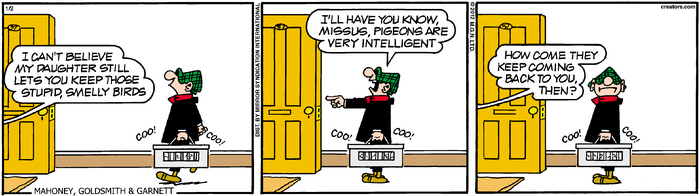
In another study, researchers led by Joël Fagot of the Mediterranean Institute of Cognitive Neuroscience tested pigeon and baboon memories. For each memory trial, the animals viewed a randomly selected picture on a computer screen with two color choices illuminated. Since the correct response was randomly chosen, yet permanently assigned at the outset, the task required memorization of each picture and its associated response. Baboons memorized a minimum of 3,500 to 5,000 items and didn’t reach a limit at the end of the three to five-year study. Pigeons memorized 800 to 1,200 pictures before reaching their limit, a capacity that is considerable and would represent a rich library of information and experience to draw on during their daily activities. You might grumble at being called "birdbrained", but next time someone calls you "pigeon brained," take it as a compliment. Psychologist Bob Cook at Tufts University of Massachusetts worked with one pigeon for 8 years and studied how good pigeon memory is. He discovered that they are remarkable visual machine and remarkable memory machine and they do that with a brain that is not much bigger than a thumb.
 The
researchers have found that brain of the pigeons process the information
in much the same manner as mammals even though brains of the birds,
unlike brains of mammals, do not have a neo-cortex. Birds’ intelligence
is found in the large amount of tissue in another part of the brain,
the paleocortex. A research done by Donald Blough and John Franklin uncovered
the ability of pigeons recognize the 26 letters of the English alphabet
although his study suggested that letters that look similar, such
as “u” and “v”, scored high rate of error
(34%). According to Blough and Franklin, the results resembled those
generated from similarity judgments by humans, suggesting cross-task
and cross-species generality in processes of letter discrimination. Click
here to view this article.
The
researchers have found that brain of the pigeons process the information
in much the same manner as mammals even though brains of the birds,
unlike brains of mammals, do not have a neo-cortex. Birds’ intelligence
is found in the large amount of tissue in another part of the brain,
the paleocortex. A research done by Donald Blough and John Franklin uncovered
the ability of pigeons recognize the 26 letters of the English alphabet
although his study suggested that letters that look similar, such
as “u” and “v”, scored high rate of error
(34%). According to Blough and Franklin, the results resembled those
generated from similarity judgments by humans, suggesting cross-task
and cross-species generality in processes of letter discrimination. Click
here to view this article.
In addition, similar experiments had shown that pigeons can be trained to distinguish between photos showing human beings and those that do not, and between photos showing trees and those that do not. Experiments with music also showed pigeons discriminating between the composers Bach and Stravinsky, and accurately classifying intermediate musical styles. Operant conditioning, or trial-and-error learning, is another type of associative learning. B. F. Skinner put lab animals in a box with a variety of levers. Test animals learned to choose only those levers that yielded food. Operant conditioning is a process where an animal learns to associate one of its behaviors with a reward or punishment and then tends to repeat or avoid that behavior. These types of experiments, was pioneered by the psychologist B. F. Skinner, who showed birds could be conditioned to perform complex tasks to get food. The experiments were done in a "Skinner Box" where birds were rewarded with food, when they pressed the lever indicating the correct answer. I think the most important part of Skinner’s experiments was when he noticed that when food was given randomly, pigeons developed behavior akin to human superstition – performing repetitive, meaningless behaviors, like a gambler in a casino. Click here to read superstition-in-the-pigeon, by B. F. Skinner.
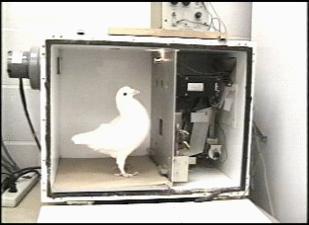 According
to Psychologist Professor Thomas Zentall and Jessica Stagner, from
the University of Kentucky in Lexington, the results of these experiments
suggest that pigeons appeared to be psychologically hooked and show
a tendency to make maladaptive decisions much the same way as humans
who buy lottery tickets and visit casinos. Researchers trained the
birds to peck on two keys to get food. One key always gave three
food pellets. If a pigeon pecked a different key it might get 10 pellets,
though
most likely none at all. Still, the researchers found that once the
birds experienced winning big, most of them tended to hit the key
that offered the possibility of hitting the jackpot. This behavior
shows pigeons prefer an all-or-nothing outcome rather than the guarantee
of a much smaller reward. The researchers say this runs contrary
to optimal foraging theory, which says animals evolve to make the
most rational choices possible to guarantee their survival. Instead
it seems pigeons behave more like human gamblers, risking everything
for the small chance of a big return. However, "pigeons
should avoid a poor gamble" Professor Zentall added, because
it might affect their survival. This behavior of taking changes even
with their lives sometimes, might explain the reasons why some Homing
pigeons (when unconditioned and/or exhausted) still try to find home
and die trying. Sometimes deep Rollers attempt to roll at low altitudes
and crash.
According
to Psychologist Professor Thomas Zentall and Jessica Stagner, from
the University of Kentucky in Lexington, the results of these experiments
suggest that pigeons appeared to be psychologically hooked and show
a tendency to make maladaptive decisions much the same way as humans
who buy lottery tickets and visit casinos. Researchers trained the
birds to peck on two keys to get food. One key always gave three
food pellets. If a pigeon pecked a different key it might get 10 pellets,
though
most likely none at all. Still, the researchers found that once the
birds experienced winning big, most of them tended to hit the key
that offered the possibility of hitting the jackpot. This behavior
shows pigeons prefer an all-or-nothing outcome rather than the guarantee
of a much smaller reward. The researchers say this runs contrary
to optimal foraging theory, which says animals evolve to make the
most rational choices possible to guarantee their survival. Instead
it seems pigeons behave more like human gamblers, risking everything
for the small chance of a big return. However, "pigeons
should avoid a poor gamble" Professor Zentall added, because
it might affect their survival. This behavior of taking changes even
with their lives sometimes, might explain the reasons why some Homing
pigeons (when unconditioned and/or exhausted) still try to find home
and die trying. Sometimes deep Rollers attempt to roll at low altitudes
and crash.
I have seen pigeons taking huge risks with their lives while maneuvering around predators at the last second. On multiple occasions I have seen a peregrine falcon dive on pigeons and pigeons continue to fly like nothing is about the attack them. They hit the brakes (stall) at the last second and watch the falcon dive by and miss them. Off course, we know that falcon doesn't always miss. Many times, I have also witnessed that flock of feral pigeons or my kit of domesticated birds flying just above the hawk. Pigeons know and trust their ability to climb a lot faster than hawks. However, they do take a huge chance, while they appear to be mocking the hawk that is flying only a few feet under them, trying to get above them to attack. I have seen my Birmingham Rollers even roll when there is a predator circling right under them. A very gutsy move, if you ask me but I guess it gives them excitement and leads me to believe that some of them are dare devils. On the other hand, some of them do exactly what I would do when a predator is around -- run. As a side note, when some Rollers attempt to roll under life-threatening situations whether that is in the presence of predator or risky deep rolls on low altitudes leads me to believe that perhaps rolling might be an addictive behavior.
Pigeon Behavior
We know pigeons are one of the very intelligent species in the animal kingdom. We also have some significant data about their social behavior. It is important to understand that some behaviors are genetically “programmed” over the course of evolution and they are therefore inherited by the future generations. Some behaviors on the other hand are result of learning, like talking, using a spoon to eat, etc. We think, make a decision, and act with our conscious mind. The conscious mind is the one we're aware of (that's what makes it conscious). The subconscious mind influences our behavior, what we actually do in response to a stimulus, fear vs. laughter. The brain carries out instinctive reactions without conscious control. Therefore, we can conclude that subconscious mind is composed of two basic elements: instincts that we inherit from our parents, and learned responses to our environment. Pigeons are considered to be highly social creatures that live in colonies, although some are observed to live in partial isolation from others. Therefore, pigeons are not required by their nature to nest in colonies, or for that matter, to nest singly in the wild. This behavior can be used as further evidence suggesting that pigeons are reasonably intelligent and complex birds in their social behavior since they are able to adjust to the social variables of colonial life or to living alone. There are some advantages and disadvantages to living in a group. There is increased intensity of competition for resources, including mate selection and increased risk of disease and parasite transmission. Although not always, living in a group also increases conspicuousness of predators or prey. However, living in a colony increase their chance of survival against predators, keeps them warm during winter, and shows role modeling for young members to learn by imitation, etc. Although there is competition for food in the colony, food sources are more easily found by groups than individuals.
 Normally,
pigeons are peaceful birds, but they will defend their territory
and nest if provoked. Serious fights are usually over nesting territory
or in
overcrowded
places. Pigeons are very territorial about their nesting place
and their perches; they continually proclaimed the ownership
of their space. They will peck towards or coo defiantly at the
other pigeons, except for their mate, their young or their nest
mates. Living in flock comes with a well-defined order known
as the pecking order. The bird at the top of the pecking order
will have first access to water, food, the best roosting place,
etc. The bird at the bottom of the pecking order has the least
rights in the flock and will usually be happy and lucky to get
the leftover food that is scattered for them. Many of the knowledgeable
pigeon fanciers know how important this could be for the new
babies that just came out of the nest, and they usually have a special
cage designed just for the young babies, called the weaning cage.
This way, they are not picked on by the dominant and older members.
Fanciers who keep their flying birds in crowded coops will notice
that even the weak adult birds will be pecked for not getting
on their designated perch and/or when they are sick. The sick
members are eliminated by a painful pecking death from the group
to protect the other healthy members. When the young birds that
just came out of the nest are placed with full of adult birds,
they learn their place in the group in a very painful way as
well, which should be avoided by the fanciers, or the stress
could cause the loss of a particular baby. Interestingly
enough, I have also witnessed in many occasions that in open
coops, young babies, who are unable to eat on their own yet,
fostered by other members if and when something happens to the
biological
parents. Although I personally do not breed in an open loft,
I have also seen birds incubating eggs that don’t belong
to them and raising someone else's babies.
Normally,
pigeons are peaceful birds, but they will defend their territory
and nest if provoked. Serious fights are usually over nesting territory
or in
overcrowded
places. Pigeons are very territorial about their nesting place
and their perches; they continually proclaimed the ownership
of their space. They will peck towards or coo defiantly at the
other pigeons, except for their mate, their young or their nest
mates. Living in flock comes with a well-defined order known
as the pecking order. The bird at the top of the pecking order
will have first access to water, food, the best roosting place,
etc. The bird at the bottom of the pecking order has the least
rights in the flock and will usually be happy and lucky to get
the leftover food that is scattered for them. Many of the knowledgeable
pigeon fanciers know how important this could be for the new
babies that just came out of the nest, and they usually have a special
cage designed just for the young babies, called the weaning cage.
This way, they are not picked on by the dominant and older members.
Fanciers who keep their flying birds in crowded coops will notice
that even the weak adult birds will be pecked for not getting
on their designated perch and/or when they are sick. The sick
members are eliminated by a painful pecking death from the group
to protect the other healthy members. When the young birds that
just came out of the nest are placed with full of adult birds,
they learn their place in the group in a very painful way as
well, which should be avoided by the fanciers, or the stress
could cause the loss of a particular baby. Interestingly
enough, I have also witnessed in many occasions that in open
coops, young babies, who are unable to eat on their own yet,
fostered by other members if and when something happens to the
biological
parents. Although I personally do not breed in an open loft,
I have also seen birds incubating eggs that don’t belong
to them and raising someone else's babies.
While the pecking order is easily observable in a pigeon coop, airborne pigeons also obey the pecking order during flight, where the pigeons in a flock follow the leader. Tamás Vicsek, a biophysicist at Eötvös Loránd University in Budapest, strapped backpacks equipped with GPS sensors to pigeons for a study. Miniature GPS loggers weighing just 16g were fitted into custom-made backpacks carried by flocks of up to 10 Homing pigeons.
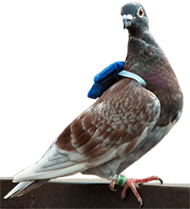 Pigeons
carrying miniature GPS devices have helped to clarify the complexities
of hierarchy in homing animals. Tamás Vicsek and colleagues
found that birds fly according to the group's pecking order,
with the leader out front. When it changed direction, its direct
followers would do the same in less than a second, and then
the more junior members of the group would respond to the direction
of those middle managers. The inconclusive part of this study
was to notice that pecking order was not always consistent
between
flights, with some rearrangement occurring among birds at the
head of the flock. While flocks have hierarchies, they’re
not dictatorships, notes Vicsek. One bird led eight of the
13 flights, while other birds took the lead on the rest of
the trips. “Maybe
someone knows the area restaurants best, or there is a person
who’s a gourmand -- or maybe they are the most outspoken” Vicsek
says. Perhaps members recognize each other’s talents
and let the most qualified lead depending on the mission. Who
knows,
maybe there is Grumpy, Doc, Happy, Sleepy, Bashful, Sneezy,
and Dopey in every pigeon flock. If they know who
is the smartest, the fastest, the best navigator, best taste
in food, best place to stay in town, then they might be chosen
to be the leader of that mission. Therefore, this research
suggests that
for pigeons,
pecking order isn’t set in stone. While one bird often
emerged as the leader, other birds might also step up to lead.
This flexible leadership has only been seen on few other colonial
animal groups. Researchers thought that the instance of the
original leader being tired might also be the answer to this
inconsistent
pecking order.
Pigeons
carrying miniature GPS devices have helped to clarify the complexities
of hierarchy in homing animals. Tamás Vicsek and colleagues
found that birds fly according to the group's pecking order,
with the leader out front. When it changed direction, its direct
followers would do the same in less than a second, and then
the more junior members of the group would respond to the direction
of those middle managers. The inconclusive part of this study
was to notice that pecking order was not always consistent
between
flights, with some rearrangement occurring among birds at the
head of the flock. While flocks have hierarchies, they’re
not dictatorships, notes Vicsek. One bird led eight of the
13 flights, while other birds took the lead on the rest of
the trips. “Maybe
someone knows the area restaurants best, or there is a person
who’s a gourmand -- or maybe they are the most outspoken” Vicsek
says. Perhaps members recognize each other’s talents
and let the most qualified lead depending on the mission. Who
knows,
maybe there is Grumpy, Doc, Happy, Sleepy, Bashful, Sneezy,
and Dopey in every pigeon flock. If they know who
is the smartest, the fastest, the best navigator, best taste
in food, best place to stay in town, then they might be chosen
to be the leader of that mission. Therefore, this research
suggests that
for pigeons,
pecking order isn’t set in stone. While one bird often
emerged as the leader, other birds might also step up to lead.
This flexible leadership has only been seen on few other colonial
animal groups. Researchers thought that the instance of the
original leader being tired might also be the answer to this
inconsistent
pecking order.
This study provided an important model for how collective behaviour and leadership can be assessed in flock of pigeons. This study also suggests that hierarchical arrangement may foster more flexible and efficient decision-making compared with that of singly led or egalitarian groups. However, it is not conclusive enough to suggest that the leader during flight is also the same leader in the pigeon coop, but their future studies will investigate whether leaders are also better navigators.
Further studies done by Dora Biro at the University of Oxford discovered how astonishingly sophisticated pigeons are when they show the ability to make group decisions based on different sets of conditions. In the study, Dora Biro used miniature GPS tracking devices to study how pairs of Homing pigeons decide between two attractive options—following a tried-and-true route home and flying alongside another Homing pigeon. When both birds in the pair had similar flight paths, the birds compromised and both flew by an intermediate route. When the pair’s preferred routes differed greatly, one bird emerged as a leader whose path both birds followed. In the same study, the scientists showed that birds flying in pairs took more efficient routes home than those flying alone, suggesting that traveling in numbers brings navigational benefits to individual group members. Click here to view this article.
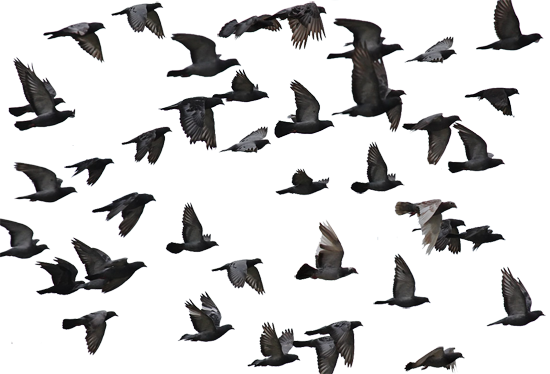 One
of the reasons why birds flock is because of vigilance behavior.
Pigeons have a very wide visual field of around 340°, compared
to the 180°of humans. In a flock, a bird looking up can be
considered more vigilant than a bird looking down, and there
is always some member looking
out for danger. If we look at the vigilance rate compared to
the number of near-neighbors, we would find that the vigilance
rate goes down with increasing flock size. But the vigilance
rates of single males are much higher than female birds. Pigeons
listen to Blue Jays, just like I do when I fly my birds. The
Blue Jay received its name because of the "jay" call
it makes when communicating with other Blue Jays, whether it
is warning of impending danger or just socializing. Blue Jays
are known for their warning of nearby predators, and pigeons,
just as many other animals, pay very close attention to Blue
Jays’ call. Once the danger is detected by a pigeon, call
for the run signal is provided that the first bird's take-off
is not preceded by preflight movements that predict its occurrence.
Therefore, the ‘meaning’ of the take-off as an alarm
signal depends on its behavioral context. Usually heavy and loud
clapping indicates fast take off from danger. When alarmed, flocks
jump into the sky and twist and turn almost as a super-organism
before setting down to resume feeding and resting.
One
of the reasons why birds flock is because of vigilance behavior.
Pigeons have a very wide visual field of around 340°, compared
to the 180°of humans. In a flock, a bird looking up can be
considered more vigilant than a bird looking down, and there
is always some member looking
out for danger. If we look at the vigilance rate compared to
the number of near-neighbors, we would find that the vigilance
rate goes down with increasing flock size. But the vigilance
rates of single males are much higher than female birds. Pigeons
listen to Blue Jays, just like I do when I fly my birds. The
Blue Jay received its name because of the "jay" call
it makes when communicating with other Blue Jays, whether it
is warning of impending danger or just socializing. Blue Jays
are known for their warning of nearby predators, and pigeons,
just as many other animals, pay very close attention to Blue
Jays’ call. Once the danger is detected by a pigeon, call
for the run signal is provided that the first bird's take-off
is not preceded by preflight movements that predict its occurrence.
Therefore, the ‘meaning’ of the take-off as an alarm
signal depends on its behavioral context. Usually heavy and loud
clapping indicates fast take off from danger. When alarmed, flocks
jump into the sky and twist and turn almost as a super-organism
before setting down to resume feeding and resting.
There
are many other advantages for pigeon flocks to occur, as we know
that flocking is not a random aggregation of birds. One of the
advantages of living in a group comes very handy during winter
roosting where the flock members can huddle shoulder to shoulder
on cold nights to reduce heat loss. Another benefit is finding
food. Food sources are more easily found by groups than by solitary
feeders. Therefore, members of a group typically have better
access to food than individuals. In addition, living in a large
group is a lot safer than living singly. We discussed that large
groups are conspicuous and easy for predators to find. However,
groups have many eyes and members are vigilant. They detect predators
at greater distances and flee before a real threat arrives. When
a hawk or falcon attacks, they try the divide and capture model
all the time, since birds separated from a flock will become
easier targets. Flocks under attack gather into tight formations
and make incredibly precise swoops and turns, which makes the
predators somewhat confused because it becomes difficult to focus
on one individual. This might be the reason why the predators
go after the odd-colored bird in the flock; perhaps it can focus
on it. During an attack, flocks form tight groups where every
individual tries to get to the center of the flock because it
is the safest position to be. Predators usually attack individuals
on the edge, and therefore, a flock member on the edge is easier
to separate from the group. Pigeons in the wild
show similar behavior while roosting, as it also provides similar
advantages where the safest position in the roost is in the middle.
Typically, there is competition to be in the middle and pecking
order solves this problem. Dominance by brute force is often
the rule, and dominant members take the safest interior spots,
leaving younger, less dominant birds to the more vulnerable,
peripheral positions.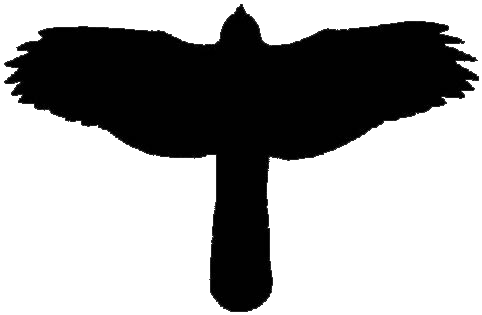
Babies and juveniles in the flock learn rules and habits pretty fast from their elders, which is an important source of adaptive behavior. Although imitative learning appears to be maximized in highly social species, it may not be an inevitable consequence of living in social groups. Imitation appears to be widely scattered among species, with humans and great apes being the most prolific imitators, but dolphins and a number of avian species including parrots, pigeons, and Japanese quail show evidence of imitative learning as well. In a study done by Joseph Campbell, The Masks of God: Primitive Mythology (New York: Viking, 1959), newly hatched chickens will dart for cover when a hawk flies overhead: yet they remain unaffected by other birds. A wooden model of a hawk, drawn forward along a wire above their coop, will send them scurrying. If the model is pulled backward, however, there was no response. The same reaction even to the shadow of hawk is seen in pigeon babies as well. This is a phenomenon reaction, as baby pigeons have never seen a hawk before, yet they are showing feared behavior even to the shadow of the predator.
The instincts make a creature react automatically to stimuli and therefore pigeons run from the shadow cast by a hawk, or a cardboard cutout of a hawk, even though they have had no previous experience with either shadow or hawk. Instincts are hardwired into the brain, the genetic legacy of millions of years of evolution and they are therefore inherited by the future generations. The brain is a mass of interconnected nerve endings so, when a pigeon sees a shadow of a hawk the nerve endings in the eye detect the shapes and shades. These nerve endings trigger impulses along the optic nerve to the brain. Such reactions are unavoidable, and followed because they are not susceptible to intellectual control. The pigeon's reaction to a shadow is not a decision the pigeon makes. It is an automatic reaction carried out by the bird's brain. An animal doesn't even know there is another way to react, and thus doesn't try to alter its reaction.
Pigeon Courtship
Pigeons mate for life, but if either bird of a pair dies or is removed, as a rule it is speedily forgotten and a new mate is accepted, but occasionally a bird will apparently grieve for its mate. Pigeons don’t have visible sex organs and unlike other types of birds, there is no characteristic difference in color between the sexes. The cock is usually larger than the hen and they have a bolder looking head. Studies suggest that females prefer mates that are physically similar to them and avoid odd color mates to ensure that the survival chances of their offspring will be higher. This hypothesis suggests that, all else being equal, color morphs will remain in fairly constant proportions over time. In pigeons, because the other sex also gives parental care, it is best to choose the most competent mate. Females are usually more discriminating than males because they normally have a greater parental investment and they therefore choose their mates very carefully. Female pigeons prefer males with the most extreme and energetic courtship displays where these characteristics may be proximate indicators of the male's health, strength, aggressiveness, and more importantly future parental ability. In the eyes of female pigeons, there is nothing sexier than a cock bird with a puffy neck, bobbing his head while walking (dancing) in circles and has deep coos. Hens, when interested, play hard to get for awhile but cannot say “NO” to the best French kisser in the entire animal kingdom.
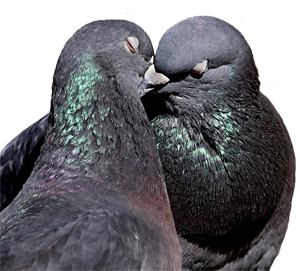 Species
often have a complex courtship ritual unique to that species.
Courtships are a series of fixed-action patterns alternately
triggered by the participants. Courtship in pigeons is very unique
because once the choice is made, most pairs stay together for
life. According to Frank Mosca, many courtship rituals that we
see in pigeons are derived from other behaviors and often seem
to be a redirection of two opposing (or conflicting) urges in
the bird that have become "ritualized" into a behavior
that each partner "understands" and in many instances
such behavior acts as a species specific separator during breeding. During
courtship, male pigeon will parade back and forth in front of
female pigeon, pushing his chest out as much as possible (filling
his air sacs with air) and cooing deeply and smoothly. As he
does
this
he will bob his head up and down and turn in circles, as if dancing
in front of the hen he has chosen. This can seem very pushy and
desperate – especially when the female ignores him.
During this stage the male pigeon also strut with the spread
tail and drags it while
he runs after a female as though he is sweeping the floor. I
am not sure what that action indicates exactly, but I am pretty
sure that doesn’t mean “Baby, choose me as your mate
and I will help you clean the house!” Hens often nods or
bobs their head, and either stand their ground, awaiting further
courting, or walk slowly and somewhat seductively to lead the
cocks on. If she is already mated, or not interested in mating,
she pays no attention to his desperate moves, and either mind
her own business or walks or flies away. The male may or may
not fly after her for more courtship, but if does, clapping his
wings harder than normal to show his strength and health to her
would not be unusual.
Species
often have a complex courtship ritual unique to that species.
Courtships are a series of fixed-action patterns alternately
triggered by the participants. Courtship in pigeons is very unique
because once the choice is made, most pairs stay together for
life. According to Frank Mosca, many courtship rituals that we
see in pigeons are derived from other behaviors and often seem
to be a redirection of two opposing (or conflicting) urges in
the bird that have become "ritualized" into a behavior
that each partner "understands" and in many instances
such behavior acts as a species specific separator during breeding. During
courtship, male pigeon will parade back and forth in front of
female pigeon, pushing his chest out as much as possible (filling
his air sacs with air) and cooing deeply and smoothly. As he
does
this
he will bob his head up and down and turn in circles, as if dancing
in front of the hen he has chosen. This can seem very pushy and
desperate – especially when the female ignores him.
During this stage the male pigeon also strut with the spread
tail and drags it while
he runs after a female as though he is sweeping the floor. I
am not sure what that action indicates exactly, but I am pretty
sure that doesn’t mean “Baby, choose me as your mate
and I will help you clean the house!” Hens often nods or
bobs their head, and either stand their ground, awaiting further
courting, or walk slowly and somewhat seductively to lead the
cocks on. If she is already mated, or not interested in mating,
she pays no attention to his desperate moves, and either mind
her own business or walks or flies away. The male may or may
not fly after her for more courtship, but if does, clapping his
wings harder than normal to show his strength and health to her
would not be unusual.
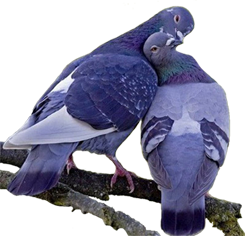
If there is a mutual agreement to mate they get very close to each other when the cock snuggles up to the hen. At this time, there is a ritual called the behind the wing preening movement which is an analogous behavior during courtship. Both sexes act as though they are cleaning their flight feathers, but this behavior seemingly give each other the signal that they are ready to commence foreplay. When it's time for them to be seemingly kissing, the cock bird opens his beak and then she puts her beak in his. During this kiss the cock offers some food through regurgitation, to prove he would be a good father and a provider. The length of the kiss is varies according to the age and desire of the birds. Usually, younger and inexperience the birds, longer the kiss and foreplay. According to Wendell Levi's book The Pigeon, during the kiss, the cock’s head and neck go through a sort of shaking and pumping motion which is akin to that of regurgitation, some substance seeming to appear in his throat. Hens receiving this offering also shows motions of swallowing although no one ever identified this substance, if in fact there is one, but every movement clearly indicates the existence of something. When the hen is more interested and ready for copulation, she will follow the cock around as if she is begging for more kiss. Soon after this, the bird courtship ritual is completed with the copulation. This procedure is known as “treading” where the hen crouches down, opens her wings a little and the cock jumps on to her back, whereupon, by means of a slight movement to one side by the hen, copulation takes place. This action is very quick, but it is not unusual for pairs to sometimes change position where females jump on the male’s back.
If other male pigeons are around, out of jealousy they will try to rush to prevent copulation, and may be successful. Odd cocks fly quickly to the engaged pair, attacking the head of either cock or hen in an endeavor to abort the proceedings. The odd hens sometimes show the same jealousy but not as frequently as the cocks. It is also interesting but not unusal, for two birds of the same sex to pair together. I was very surprised to find 4 eggs under a pair one morning, and I thought I had quadruple twins before I realize I had unintentionally mated two females together. When mates of opposite sex are not available because fanciers separate hens from cocks until the breeding season, cocks sometimes mate with cocks, and hens with hens.
 Unlike
wild pigeons, in a domestic flock of pigeons we do not give our pigeons
the choice of who their mate
is going to be. Pigeon fanciers select pairs for variety of reasons
and anticipation, and majority of them do not breed in open lofts.
Pairs are normally locked up in an individual breeding cage and forced
to mate with the individual that is selected for them. Most domestic
pigeons do not have any problems with that, although some might
reject to mate with the individual selected for them. Studies suggest
that choice that pigeons make selecting
their mate in wild populations is far from
random. Mate choice is a serious decision, perhaps
because pigeons remain paired for life. Most pigeons live in large
population of flocks which gives them the luxury of choosing their
mates from many possible candidates. Pigeons employ at least seven
different characteristics in judging other individuals as possible
lifetime partners. They use age, previous breeding experience, relative
dominance status, body size, feather condition, plumage color, and
plumage pattern when looking at possible partners. Hens are usually
the most discriminating of the sexes, and studies suggest that, it
is they who choose mates based on the above criteria. Cock birds
on the other hand look more for large size or previous experience
when looking at possible partners. In addition, blue bars raised
by two blue bar parents tended to pick blue bars for mates. Blue
bars raised where at least one parent was a check still preferred
blue bar mates but not as strongly. Consequently, the check pattern
birds tended to pick check pattern birds for mates. Sexual mate selection
is pretty strong in most organisms so such a result should not be
at all surprising in pigeons.
Unlike
wild pigeons, in a domestic flock of pigeons we do not give our pigeons
the choice of who their mate
is going to be. Pigeon fanciers select pairs for variety of reasons
and anticipation, and majority of them do not breed in open lofts.
Pairs are normally locked up in an individual breeding cage and forced
to mate with the individual that is selected for them. Most domestic
pigeons do not have any problems with that, although some might
reject to mate with the individual selected for them. Studies suggest
that choice that pigeons make selecting
their mate in wild populations is far from
random. Mate choice is a serious decision, perhaps
because pigeons remain paired for life. Most pigeons live in large
population of flocks which gives them the luxury of choosing their
mates from many possible candidates. Pigeons employ at least seven
different characteristics in judging other individuals as possible
lifetime partners. They use age, previous breeding experience, relative
dominance status, body size, feather condition, plumage color, and
plumage pattern when looking at possible partners. Hens are usually
the most discriminating of the sexes, and studies suggest that, it
is they who choose mates based on the above criteria. Cock birds
on the other hand look more for large size or previous experience
when looking at possible partners. In addition, blue bars raised
by two blue bar parents tended to pick blue bars for mates. Blue
bars raised where at least one parent was a check still preferred
blue bar mates but not as strongly. Consequently, the check pattern
birds tended to pick check pattern birds for mates. Sexual mate selection
is pretty strong in most organisms so such a result should not be
at all surprising in pigeons.
Another interesting phenomenon in pigeons is that although they claim to be monogamous (a mating system where one male mates with one female), it should not be surprising to see a male pigeon offering his seeds to any other females who are interested in receiving them. If odd cocks and odd hens are kept in the same pen with mated pairs, occasionally a paired cock will desert his spouse for a new mate or possibly take two mates. Although he goes back to his nest after cheating on his hen, this action is suggesting pigeons are more like polygamous (a mating system where an individual of one sex mates with several of the other). I have seen some fanciers designing a special mating cage with two rooms or floors where there is a nesting bowl, water and feeder in each compartment. It is designed to breed one cock bird with two hens, to raise 4 babies at a time and it has been successfully done. It must be a lot of burden on the cock birds to help raise 4 babies from two hens.
Pigeons have complex emotions, and each pigeon has a unique personality. Some are more social, some are loners. Some are friendly, some are hostile. Some are curious, some are timid. Some are aggressive and competitive, some are fat and lazy. Some are true performers, and some only perform to impress females. Some males try to impress the females all the time; some are not interested in mating at all. Most of them are great parents, and some should not be allowed to be parents...I can't help but wonder, do pigeons behave and show characteristics like humans? I definitely think so.
“People and pigeons are curiously much alike. That is to say the lovely birds have those qualities of fidelity, affection, and love, courage, determination, and pride which are qualities humans may boast of when they are at their best. If they display jealousy and pettishness, quarrelsome moments and gluttony they should be forgiven, for their sin are small…In some things they shame us, by and large. Once mated, they are wed for life unless forcibly separated. When set to the task, such as a long race, they will persevere and endure through measures of hell that only the best of men will willingly undertake” (R. Write Campbell, Where Pigeons Go To Die, p. 1).
Ancestors of
Pigeons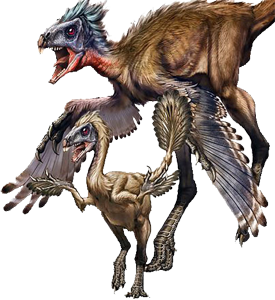
The idea that birds descended from dinosaurs may seem completely ridiculous to many people--after all, birds are small, light, fluttery creatures, while dinosaurs were huge, plodding, and distinctly not aerodynamic. This idea that the ancestry of birds can be traced back to carnivorous dinosaurs called theropods promulgated by British anatomist Thomas Henry Huxley nearly 150 years ago suggesting that there was nothing wild or illegitimate about this connection. In the ensuing years, a myriad of skeletal features supporting the dinosaurian origin of birds was discovered in the fossils of large and small theropods – hollowed bones, elongated forelimbs, large breastbones, and even wishbones are some of the futures typical of avian skeleton that have by now been found among these dinosaurs. In addition, the shape of the eggs and the microscopic structure of the eggshell of theropods were shown to be similar to that of birds as well as the pattern of egg-laying of all these animals was found to be comparable. These discoveries proved that some of these dinosaurs brooded their offspring in a fashion similar to that of birds and that they adopted resting poses that would be familiar to any birder.
Furthermore, other evidence was found that suggested small dinosaurs possessed feathers, beaks, and other birdlike characteristics. The enormous significance of these fossils notwithstanding, the documented existence of feathers in dinosaurs has thus far been limited to a dozen or so species, all of them circumscribed to East Asia. These discoveries have established beyond any reasonable doubt that birds evolved from carnivorous dinosaurs gifted with the plumages and exuberant behaviors that we see today in their descendants.
Overwhelming evidence suggests birds evolved from dinosaurs some 150 million years ago, but one of the missing pieces to the evolutionary puzzle is how such birds took to the air. It's a common mistake among people unversed in evolutionary theory to assume that feathers evolved specifically for the purpose of flight. However, evolution is a blind process--it doesn’t "know" where it's going until it gets there. For this reason, the accepted explanation is that dinosaurs evolved feathers as a means of insulation in cold climates and, possibly, as a way to puff themselves up in the eyes of the opposite sex. This theory can be supported by the fact that even birds that have been flightless for millions of years still have feathers. If the purpose of feathers were solely to power flight, there would be no reason, from an evolutionary perspective, for penguins to keep their feathers.
Based on evidence found so far, it is conclusive that birds and mammals both evolved independently from reptiles. The earliest fossil of a bird is long, about the size of a crow, has tapering tail, claws and teeth which are all characteristics of a reptile. The only difference from a reptile is their wings have well-developed feathers. Scientists believe they might have evolved from a small running dinosaur, and it was probably a poor flyer. The keratin found in their feathers is the same material found in the scales of reptiles. Reptile-like scales found on pigeons’ leg and feet as well as the claws and beak are other indications of a close relation to reptiles. As a result, nearly all working paleontologists accept the conclusion that birds are descended from feathered theropod dinosaurs.
Pigeons & Human Interaction
When did pigeons and humans
first interact? The first images of pigeons found by archaeologists
in Mesopotamia (modern Iraq), date back to 3000 B.C. although some
argue that domestication may have taken place as early as 10,000
years ago. Levi (1963) points to archeological records such as terra
cotta
figures found in present day Turkey dating from the fifth century
B.C. and also a Greek grave stone depicting a man affectionately
holding two pigeons -- dating from 500 B.C. In all the ancient civilizations,
from early Mesopotamia through Greece, Egypt and Rome rock doves
had their admirers, breeders and keepers. Once man started city states
between the Tigris and Euphrates, a lot more grain was needed to
be grown and harvested than it used to be to feed all the citizens
of the city. The rock doves took advantage of that extra seed and
grain found around the cities and bred more profusely. We know that
pigeons will continue to breed as long as a good food supply is available.
Man in turn, took advantage of the rock doves themselves and climbed
the cliffs and rocks to collect the eggs and squabs for food. Way
before chickens, pigeons used to be human’s domestic food supply.
Although a fairly timid bird in the wild, if taken when young, pigeons
showed a tendency to be domesticated providing a regular source of
food during difficult times. 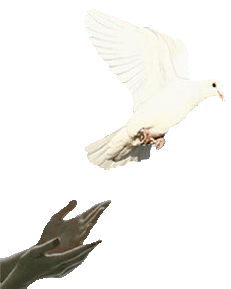
It was the Sumerians in Mesopotamia that first started to breed white doves from the wild pigeons. The white pigeons have been recognized as a symbol of love, peace and a new beginning. In many cultures, white doves represent the Holy Spirit and the soul and are further symbolic of hope, innocence, tenderness and purity. Ancient and modern civilizations fly white doves in ceremonies celebrating devotion, partnership and fertility. The use of snow white doves at weddings is traced back to ancient Greek and Roman times when the doves were gifts from the Bride to the Groom as the symbol of innocence and fidelity.
Ancient civilizations have worshiped pigeons. For the Sumerians, they were the messengers to the Gods. For the Greeks and Romans they were symbols of fertility. The first biblical reference to the pigeon (or dove) was in the Old Testament of the Bible in the first millennium AC and was the story of Noah and the dove of peace. In Genesis 8: 6-11 Noah sends out a pigeon three times to find how things are going on earth after the Great Flood. The first time she cannot find a place to rest on the waters, and returns fruitlessly. The second time she brings back a fresh olive branch from her trip of discovery. When released for the third time, she does not come back at all, a sign that the flood has finally subsided. Later, in the New Testament, the pigeon was first mentioned during the baptism of Christ where the dove descended as the Holy Spirit, an image now used extensively in Christian art. Many religious groups including Muslims, Hindus and Sikhs feed pigeons for religious reasons. Many older Sikhs feed pigeons ceremoniously to honor the high priest and warrior Guru Govind Singh who was a known friend of the pigeon (or rock dove). Some Sikhs also feed pigeons because they believe that when they are reincarnated they will never go hungry if they have fed pigeons in their previous life.
Other
religious groups in India believe that when a person dies his or
her soul assumes the form of a bird (normally a pigeon) and therefore
by feeding birds they are caring for the souls of their departed
ancestors. The pigeon is revered in India with huge flocks numbering
many thousands of birds being fed daily at Hindu temples in town
and city centers throughout the country. In both eastern and western
societies many of the most entrenched pigeon-related problems in
urban areas are considered to be caused, certainly in part, by
religious feeding of the birds. 
In ancient times pigeons were the fastest way to send messages. There are writings that report that the Persian King Cyrus used birds to send information, and the Greeks used Homing pigeons to send news of Olympic victories. During the first Olympic Games in Greece in 776 B.C., a pigeon carried winners' names to the empire's farthest reaches. Macedonians and Greeks under the leadership of Alexander the Great used pigeons as messengers. Even Julius Caesar used Homing pigeons to carry messages of importance. Pigeons carried reports of Caesar's conquest of Gaul back to Rome. The Carthaginian General Hannibal used pigeon to relay information while crossing the Alps 200 years before the time of Christ. Pigeons appear on Egyptian bas-reliefs from at least 2700 B.C. From Homer (circa ninth century B.C.) to Socrates (469-400 B.C.) to Aristotle (384-322 B.C.), the Greeks displayed knowledge of the pigeon’s habits and abilities and wrote about issues of selective breeding and domestication (Levi 1963: 30). Roman records from as far back as 200 B.C. document the force-feeding of pigeons for purposes of fattening them for consumption. Messenger pigeons, more commonly known as Carrier pigeons, were used as early as 1150 in Baghdad and also later by Genghis Khan. In the great religions of the world, the pigeon has occupied a position of reverence where biblical information reference pigeons with frequency.
Pigeons have been domesticated for thousands of years for their roles in human lives as symbols of gods and goddesses, sacrificial victims, messengers, pets, food and even war heroes. Pigeons and doves have been immortalized in poetry and prose, music and art. In literature, the pigeon is frequently mentioned by Homer, Socrates, Aristotle and Pliny. William Shakespeare was either a pigeon breeder or was associated closely with someone that was, since he exhibited a precise knowledge of pigeons in many of his works. The pigeon droppings were used as a fertilizer and later as gun powder by the Turks. In ancient Turkey, cave dwellers carved pigeon roosts in the cliff faces, attracting the birds for easy gathering of their droppings. Pigeons were also kept for their nitrogen-rich guano, or feces, which is likely one of the first types of fertilizers used by newly emerging agricultural societies.
Pigeon meat has been a staple of some cultures and a delicacy among others. It is preferable to eat young pigeons-called squab-before their meat gets too hard. In France today, squab is often served in the finest restaurants. Squab has been and still is eaten in the United States as well. In Iran, where eating pigeon flesh was forbidden, dovecotes were set up and used simply as a source of fertilizer for melon crops and in France and Italy it was used to fertilize vineyards and hemp crops. For centuries in England, only the wealthy were allowed to raise pigeons for food. In the 17th century, King George I of England, decreed all pigeon droppings to be property of the Crown - and the “lofts” were policed to enforce the law! The valuable pigeon manure was used to manufacture saltpeter, a critical ingredient for making gunpowder. During the eighth century in France, only the nobles had Homing pigeons and the birds were considered a symbol of power and prestige, until the French revolution changed things so that the common man could have them.
Messenger Pigeons
Pigeon's ability to find home created the communication revolution. By the 16th century Messenger pigeons were being used in formal postal services. In 1860, Paul Reuter, who later founded Reuters Press Agency, employed a fleet of 45 to deliver news and stock prices between Brussels and Aachen. Possibly the first regular air mail service in the world was Mr. Howie's Pigeon-Post service from the Auckland New Zealand suburb of Newton to Great Barrier Island, starting in 1896. The first message was carried in January 1896 and took less than 1.75 hours to reach Aukland. Up to 5 messages were carried by each pigeon with the record time for the journey being held by a pigeon called ‘Velocity’ taking only 50 minutes and averaging 125 kmph (only 40% slower than a modern aircraft!). Certainly the world’s first 'airmail' stamps were issued for the Great Barrier Pigeon-Gram Service from 1898 to 1908.
Messenger pigeons delivered messages for major military powers since the Egyptians, changing the course of battles and human history. There are many historical accounts of pigeons being used in wars and conflicts during medieval times. News of Napoleon's defeat at Waterloo reached England by pigeon days before messengers arrived via horses and ships. 95% of the pigeons used during combat successfully delivered the message, more reliable than radios in the battle field. One thing to pigeon messenger success is their speed. To send a message 80 km (about 50 miles), a world class human runner would need almost 5 hours, and a horse almost 2 hours, but a pigeon less than 60 minutes. Telegraph and phone lines were regularly cut or destroyed. Pigeons were used to send sensitive messages by both sides. It is believed that during World War I over half a million pigeons were used by armies as a reliable communication.
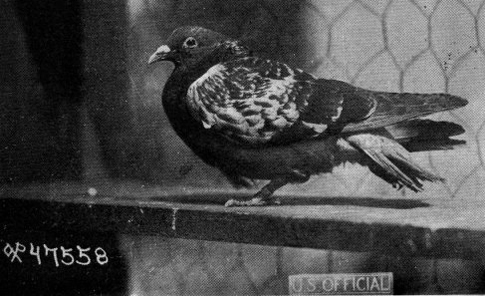 In
October 1918, as the war neared its end, 194 American soldiers found
themselves trapped by German soldiers. They were cut off from other
Allied soldiers and had no working radios. The only chance they had
of alerting anybody about their desperate situation was to send a
pigeon with their coordinates attached to its leg. The pigeon's name
was Cher Ami (French for dear friend,
picture on the left). When released, Cher Ami flew 25 miles from
behind German lines to the Americans' headquarters. Cher Ami covered
the
25 miles in just 25 minutes. The German soldiers saw the bird take
flight and began firing upon the bird wounding it but not enough
to take away its will to fly back to the command post. Cher Ami arrived
with one eye shot out, a bullet in its breast and most of the leg
missing that had the message capsule still attached – hanging on
only by a tendon. With the "Lost Battalion's" coordinates,
the Americans launched a rescue and the 194 men were saved. Cher
Ami was awarded the Croix de Guerre with Palm for its astonishing
flight. After healing, Cher Ami went on to receive an honorary service
cross and taken back to America and lived until 1919. “Cher
Ami”, (picture on left) in his cage in Washington standing
on his only leg. Later he was mounted and then placed on display
in the Smithsonian Institute.
In
October 1918, as the war neared its end, 194 American soldiers found
themselves trapped by German soldiers. They were cut off from other
Allied soldiers and had no working radios. The only chance they had
of alerting anybody about their desperate situation was to send a
pigeon with their coordinates attached to its leg. The pigeon's name
was Cher Ami (French for dear friend,
picture on the left). When released, Cher Ami flew 25 miles from
behind German lines to the Americans' headquarters. Cher Ami covered
the
25 miles in just 25 minutes. The German soldiers saw the bird take
flight and began firing upon the bird wounding it but not enough
to take away its will to fly back to the command post. Cher Ami arrived
with one eye shot out, a bullet in its breast and most of the leg
missing that had the message capsule still attached – hanging on
only by a tendon. With the "Lost Battalion's" coordinates,
the Americans launched a rescue and the 194 men were saved. Cher
Ami was awarded the Croix de Guerre with Palm for its astonishing
flight. After healing, Cher Ami went on to receive an honorary service
cross and taken back to America and lived until 1919. “Cher
Ami”, (picture on left) in his cage in Washington standing
on his only leg. Later he was mounted and then placed on display
in the Smithsonian Institute.
During World War II, the Irish Paddy and the American "G.I. Joe" both received the "Dickin Medal", and were among 32 pigeons to receive this medallion, for their gallantry and bravery in saving human lives with their actions. Paddy (Pigeon number NPS.43.9451) was an Irish carrier pigeon awarded the Dickin Medal after being the fastest pigeon to arrive back in England with news of the success of the D-Day invasion, out of hundreds dispatched. He flew 230 miles across the English Channel in four hours and fifty minutes, the fastest recorded crossing, and was awarded the medal on September 1, 1944, just less than three months after the crossing. Paddy was trained by Andrew Hughes of Carnlough and is the only animal in Ireland to be awarded this medal. The medal citation reads: "For the best recorded time with a message from the Normandy Operations, while serving with the RAF in June, 1944." His medal was sold at auction for almost £7,000 in September 1999. A pigeon named “G. I. Joe” saved over 1000 lives of a thousand soldiers in World War II after British troops had established a position within an Italian town that was due to be bombed by the Allied forces on October 18, 1943. Communication equipment was down and the only means of stopping the raid was to attach a hastily written message to G.I. Joe and send him to the HQ. G.I. Joe flew 20 miles in 20 minutes arriving at the air base with the message that the British had captured the village. G.I. Joe, arrived just in time to avoid the bombing.
Believe it or not, Homing pigeons were still employed in the 21st century by certain remote police departments in Orissa state in eastern India to provide emergency communication services following natural disasters. In March 2002, it was announced that India's Police Pigeon Service messenger system in Orissa was to be retired, due to the expanded use of the Internet. The use of pigeons to carry messages is commonly called Pigeon post. Pigeons can also carry small light-weight packages, and have been used to smuggle drugs into a prison. The humorous IP over Avian Carriers (RFC 1149) is an Internet protocol for the transmission of messages via Homing pigeon. Originally intended as an April Fools' Day RFC entry, this protocol has in fact been implemented and used, once, to transmit a message in Bergen, Norway on April 28, 2001.
Pigeon’s Navigational Ability
Scientists agree that pigeons use the sun to navigate, remembering and memorizing visual land marks, following other trails (road, railroad, river, beach, etc.), use their exceptional ability to smell and even use the world’s magnetic fields. The arguments still rages on between the scientists about how pigeon find home and there seems to be disagreement about which navigational cue is the most critical.
At the University of Oxford, Dr. Tim Guilford says pigeons have an internal clock, anticipating where the Sun should be in any given time of the day, called the sun compass. Dr. Guilford says pigeons' used their ability to navigate by the Sun when they were over unfamiliar territory. They also have an aerial road maps signs to find their way home. According to Dr. Guilford, pigeons almost always use a habitual route back home showing the same flight pattern, turning at certain land marks. Although pigeons don't follow linear lines all the time and sometimes when they're flying at 200 or 300ft above built-up areas it's difficult to see exactly what they are following. However, when they do follow a road, it's so obvious especially when they turn off at particular junctions. It's very human-like.
 At The University of
New Hampshire, Dr. Brett Gibson studies how pigeons recognize the
world around them. Dr. Gibson and his colleagues found that humans
and pigeons, which have different visual systems, have evolved to
use similar techniques and information to recognize objects. According
to Dr. Gibson, the key is reading between the lines, which mean we
can’t tell what the object is until we see the whole object.
Pigeons also use the outline of the objects to recognize and discriminate
objects. Therefore outlines are critical information for an animal
high in the sky trying to find its way home; identifying land marks
like highways and buildings.
At The University of
New Hampshire, Dr. Brett Gibson studies how pigeons recognize the
world around them. Dr. Gibson and his colleagues found that humans
and pigeons, which have different visual systems, have evolved to
use similar techniques and information to recognize objects. According
to Dr. Gibson, the key is reading between the lines, which mean we
can’t tell what the object is until we see the whole object.
Pigeons also use the outline of the objects to recognize and discriminate
objects. Therefore outlines are critical information for an animal
high in the sky trying to find its way home; identifying land marks
like highways and buildings.
At University of Pizza in Italy, Dr. Anna Gagliardo’s theory for pigeons to find home is odors from the surrounding environment tell pigeons where they are or where to go. From the first day of life pigeons catalog different smells around their lofts like oceans, forest, or cities. They build a virtual scent map in their minds navigating long distances by the intensity of the smell. When their smelling ability has been disabled by surgeons, they have hard time finding home and some even got lost.
Another
pigeon researcher at the University of Frankfurt, Gerta Fleissner
claims pigeons along with countless other animals travel long distances
because they are wired into the Earth’s magnetic fields crossing
continents and oceans. Pigeons deep in their nerve endings of their
upper beaks have hundreds of magnetite highly sensitive to magnetic
fields. They are found in 3 different shapes and structures giving
the pigeons 3 dimensional information about the Earth’s magnetic
field. In other words, pigeons have built in state of the art tracking
device.
The rock dove’s ability to find home from a distance was noticed by man quickly and they have been kept for sending messages back home from war zones and distant cities. The ones which have the more talent and the body type to come home fastest have been interbreed to produce better quality birds for generations. Man has always been a collector and quick to spot the unusual, so he would have noticed the odd white feathered bird and as time passed these odd birds would have been spared and then interbred to produce more varied and unusual birds. After many years of domestication and man's selective breeding, variety of talents (fast flying, endurance flying, tumbling, rolling, diving, singing, etc.) various colors, shapes and sizes developed all for human pleasure and needs. The mankind has substantially altered the morphology and the behavior of the domesticated descendants of the rock dove to suit his needs for food, aesthetic satisfaction and entertainment. Now, all over the world, thousands of pigeon lovers and breeders from all different backgrounds have a great bond of brotherhood because of their common interest - the pigeon.
"Just what it is
that makes one love pigeons is hard to analyze. Some seem born with
this love an inherit part of them. They acquire their birds in their
early youth and never part with them; others commence their rearing
at a later period, and either soon part with them or develop into
enthusiastic fanciers. There seems to be no middle ground; one either
loves pigeons or one does not. That man is fortunate who finds in
his breast an inexplicable love for them. To him, is affordable a
hobby of immeasurable value. When fortune frowns and when the cares
of a harsh or disordered world seem almost too heavy to bear; when
the grim reaper has taken some loved one; or when nerves are tense
almost to the breaking point, then the pigeon lover finds in his
birds a solace and consolation impossible to describe. When, through
some temporal triumph, one is prone to be impressed with his own
prowess, then again, by contemplating the ways of the pigeon, the
great temperer, one is brought back to the norm. The pigeon proves
a stabilizer, leveling the depths of depression and the heights of
false ecstasy, as he 'keeps the even tenor of his way,' always happy,
always devoted, always indifferent to the vagaries and the tribulations
of the human soul. The pigeon lover unwittingly absorbs his calm
'philosophy' " (Wendell Levi, The Pigeon, p. 34).
The pigeon breeding is a lifelong hobby to many people whether they begin as a child or later in life. The estimated number of people that raise pigeons in the United States and Canada is over 50,000. Many fanciers enjoy the challenge of breeding their birds to a standard of perfection, while the hobby itself is very relaxing and full of joy when breeder is in contact with pigeons and the nature. The pigeon breeding hobby is relatively inexpensive and pigeons do not require a large amount of space to fit well around the houses. Most pigeon coops are attractive and they are positive addition for the homeowner.
Most pigeon breeders like to attend the pigeon shows to exhibit their birds, compare them to others, and bond with other pigeon breeders at local, inter-state or national shows. The pigeon shows are much like a dog show where each breed is compared to a written standard of perfection. Most pigeon shows are held in the fall of the year, but a few are offered throughout the year. In the U.S.A., there are hundreds of local, state and national pigeon clubs that sponsor shows. The largest shows are the National Young Bird Show, held in Louisville, Kentucky in October, and the National Pigeon Association's Grand National which is held in a different city each year, usually in January. Most pigeon shows are free to the public, and they are very informative and entertaining way to see some of these marvelous birds. Pigeon breeders and fanciers take their prize birds to exhibitions or shows throughout the country where each breed is evaluated by qualified judges for their feather quality, color, expression, body confirmation, markings and feather ornamentation.