Ash-red Ratio In Feral Pigeons
By Arif Mümtaz
December
2009
 The
ancestor to our domestic pigeons, the rock-dove (Columba livia), is
considered to be the wild-type
(the standard against which we judge everything) in pigeon genetics.
Rock-doves originated in Africa, Asia, Europe, and the Middle East.
Its domesticated form, the feral pigeon, has been widely introduced
elsewhere, and is very common, especially in cities, over much of the
world. The pigeon populations we find in the cities are established
with rock-dove
and by escaped domestic pigeons, so we refer to them as “feral pigeons”.
The term "wild" is reserved for pigeon populations that were never
domesticated and still live in their native habitats which are cliffs,
usually on coasts. Ferals are distinctly different, with their own characteristics
that set them apart from their domestic and wild ancestors. Feral
pigeons grow or develop vigorously around human habitation, as they
utilize buildings as nesting sites and consume scraps and other unwanted
food. We still
call ferals their scientific name "Columba livia" which is
Latin for blue-gray dove or pigeon, but
unfortunately most of us don’t
show them the respect these very special birds deserve.
The
ancestor to our domestic pigeons, the rock-dove (Columba livia), is
considered to be the wild-type
(the standard against which we judge everything) in pigeon genetics.
Rock-doves originated in Africa, Asia, Europe, and the Middle East.
Its domesticated form, the feral pigeon, has been widely introduced
elsewhere, and is very common, especially in cities, over much of the
world. The pigeon populations we find in the cities are established
with rock-dove
and by escaped domestic pigeons, so we refer to them as “feral pigeons”.
The term "wild" is reserved for pigeon populations that were never
domesticated and still live in their native habitats which are cliffs,
usually on coasts. Ferals are distinctly different, with their own characteristics
that set them apart from their domestic and wild ancestors. Feral
pigeons grow or develop vigorously around human habitation, as they
utilize buildings as nesting sites and consume scraps and other unwanted
food. We still
call ferals their scientific name "Columba livia" which is
Latin for blue-gray dove or pigeon, but
unfortunately most of us don’t
show them the respect these very special birds deserve.
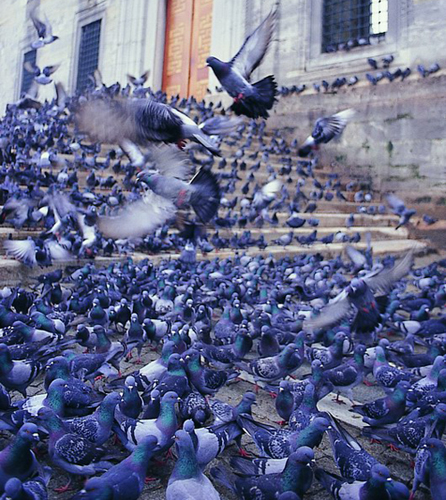
I am originally from Turkey and pigeon culture in Turkey is very unique as many of the breeds originated from the Ottoman Turks and Middle East. Turks feed feral pigeons on the streets of cities for good luck. It is a custom in Turkish culture to feed the feral pigeons usually nearby a mosque to do a good deed. If you ever travel to Turkey, especially to Istanbul, you will see them everywhere and you will have a chance to feed them where street vendors sell packets of seeds for visitors to feed the pigeons. The picture on the left is taken in Istanbul, Turkey.
I have traveled to many cities in the USA, Canada, Central and South America, Europe, and South East Asia. Everywhere I went, I have always noticed and observed the ferals on the streets, on buildings and while they are in flight. Some feral populations are evidently distinct on phenotype and it varies quite a bit as you go around their native range - for example, 80% of the birds in Honolulu, Hawaii, are in white plumage - but all can be shown to be in some degree different from both their wild and domestic ancestors.
In England and the channel coast of Europe we find mainly blue bars. In the Ural Mountains the wild birds are near 100% smoky. I saw a lot of white plumage: recessive white, pied, and/or grizzles in the feral populations of Hong Kong, Vietnam, Thailand, and Singapore. When we go to hotter climates the wild Columba livia tend to get darker from blue bars to checkers and t-checkers, and even spread blacks. There are two mutants which are thought to be alleles on the sex chromosome with the blue/black pigmentation found in pigeons. One of these alleles causes brown and the other causes ash-red. These two mutations must be very old since both of these mutants are spread over nearly all domesticated breeds. It is very interesting that about 95% of the world’s feral pigeon colonies and wild-type populations are blue/black plumage which brings out my main question: Why don’t we see a lot more ash-red colors than blue/black pigeons in the wild, if ash-red is a dominant mutation to the blue/black pigmentation found in wild-type?
In the feral populations, it appears to be some tendency for pigeons to get darker colored as the average temperature rises, and the average UV exposure increases. Consequently, we would find more checkers and dark checkers when we get closer to equator or hotter climates and find blue bars and lighter colors in colder climates. This may be a result of darker bird’s feathers screening out visible light while lighter feathers allow the light to get to the skin resulting in over heating the pigeon. It may also be a result of birds with darker feathers being more resistant to UV damage than the birds with lighter feathers. In high sun areas, particularly as you go towards the equator, feather wear even in domestics becomes very noticeable. Studies show that ash-reds have very little pigment in both primary flights and the tail and if bar pattern also the shield. This could put ash-red at a disadvantage screening out visible light to the skin resulting in over heating the pigeon and causing them to be less resistant to UV damage. Also, cities tend to be a lot hotter in summer than country only a few miles away. If high temperatures influence survival we could expect to see a difference in color variation over pretty short distances sometimes. Temperature therefore is one of the factors responsible for color and pattern variety we notice around the world, where some wild species successfully adopted the climate as in snow pigeons and wood pigeons. Perhaps the climate is one of the reasons why we don’t see variety of colors in the wild; instead we see variety of patterns where blue/ black pigmentation seems to be working better in different climates.
Pigeons have very different predator issues in different places that can impact what survives and what gets eaten. Some places Hawks might be a major predator and in others it might be cats, snakes, owls, raccoons, or other predators. The most regular consequence of life in the wild is that unusual plumage color and pattern combinations are removed first by predators. Many of these, such as house cats, cooper's hawks, peregrine falcons, or goshawks organize their hunting on the basis of recognizing odd individuals. Successful hunting begins with focusing on one individual, which allows a single bird to be chased from a flock of dozens. One result is that 95% or more of the birds in feral groups will be in blue bar, blue checker, blue T-pattern, or spread plumages, with a few other possible plumages irregularly represented in the remaining birds. Perhaps for predators, focusing and concentrating on an odd color plumage is a lot easier to pick for a target than the birds that blend in. This brings out another possibility of why ash-red ratio would be so low in feral pigeons. However, according to a 1991 study by James B. Armstrong, Department of Zoology and Wildlife Science and Alabama Agricultural Experiment Station, Funchess Hall, Auburn University, AL, there is not much of a correlation between pigeon colors and vulnerability to raptor attacks.
“Previous discussions with racing pigeon fanciers suggested a possible correlation between pigeon color and vulnerability to raptor attack. However, 235 of the respondents (64%) indicated that any color pigeon was likely to be taken. The second most frequent choice was blue or ash-red (24%, n = 87). While 264 of the respondents (72%) indicated that any age bird could be taken, there did appear to be a bias toward young birds from those respondents who observed a difference (17 % young birds vs. 10% old birds). Nationwide, 52% of the 367 respondents (n = 191) indicated Cooper's hawks were the raptor most often responsible for pigeon attacks (Table 2). Red-tailed hawks (Buteo jamaicensis) were the next highest (19%, n = 71).”
Click
here to read the rest of this article. 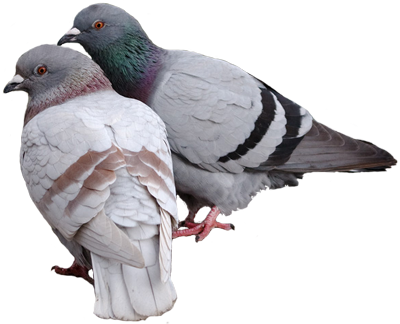
The other possibility which might influence ash-red ratio in feral pigeons is the mate selection. Unlike feral pigeons, in a domestic flock of pigeons we do not give our birds the choice of who their mate is going to be. Studies suggest that mate choice in feral populations is far from random. Mate choice is a serious decision in feral pigeons, perhaps because pigeons in wild remain paired for life unless one of the two dies.
Most pigeons live in large population of flocks which gives them the luxury of choosing their mates from many possible candidates. Pigeons employ at least seven different characteristics in judging other individuals as possible lifetime partners. They use age, previous breeding experience, relative dominance status, body size, feather condition, plumage color, and plumage pattern when looking at possible partners. Hens are usually the most discriminating of the sexes, and studies suggest that, it is they who choose mates based on plumages. Cock birds on the other hand look more for large size or previous experience when looking at possible partners. In addition, blue bars raised by two blue bar parents tended to pick blue bars for mates. Blue bars raised where at least one parent was a check still preferred blue bar mates but not as strongly. Consequently, the check pattern birds tended to pick check pattern birds for mates. This could be another explanation why the ash-red ratio is so low in wild, where feral pigeon's mate selection creates pressure against ash-red color. Sexual mate selection is pretty strong in most organisms so such a result should not be at all surprising in pigeons.
When Darwin was studying pigeons, and wrote his The Origin of Species, he devoted the whole first chapter to the domestication of pigeons. He discovered that if the different fancy breeds were mated, the offspring would eventually lose their distinctive traits and resemble the rock-dove. Darwin called this phenomenon “reversion.” According to Darwin there was no other reasonable explanation for the profusion of fancy pigeons. Many pigeon breeders, who have been around pigeons for long time, experience a reversion, where two distinct colors and patterns are bred the offspring lose their recessive genes and show the markings and the color of an ordinary rock-dove. Therefore, reversion could be another reason why the ash-red ratio is low in feral pigeons. This also means that the dominant mutation doesn’t necessarily become more common or necessarily better or stronger than a recessive allele.
Another theory is the constant influx of mutant color genes in to feral flocks. Ferals we see in cities tend to show less variation in color phenotype than ferals found in rural areas. Pigeons found in country and farms show much greater variation in color mutants than the pigeons we see in the cities. This could be the result of a founder effect. If there is a barn or a bridge that is pretty isolated but also has a good food sources close by, we would expect to get few new birds moving into the flock over time. Therefore, founder genes tend to persist for a fairly long time in an isolated flocks. For some reason something about the city life that simply favors blues very strongly. Nearly every city is almost nothing but blue bars and blue checks with few exceptions of all kinds of recessives in them. The occasional pied and very rarely a recessive white can be seen in some flocks, lots of dirty blues and very few spreads.
Nowadays, one of the main contributors to the feral gene pool is lost Racing Homers. A lot of city flocks are starting to look just like Homers, which are mainly blue bars and blue checks. So all these lost Homers every year are driving the gene pool towards the mutants common in Homers. Therefore, it is not unreasonable to expect the feral population to be moving in the direction of Homer colors. Generally a lot more blue checks than blue bars.
“The Hardy Weinberg Equation” - In 1908, G.H. Hardy and W. Weinberg independently suggested a scheme whereby evolution could be viewed as changes in frequency of alleles in a population of organisms. Hardy and Weinberg also argued that if certain conditions were met, the population's alleles and genotype frequencies will remain constant from generation to generation.
According to Frank Mosca, “It's a basic in biology and it's expressed by the Hardy-Weinberg law. Alleles (alternatives such as brown, wild-type, ash-red) exist in equilibrium in the gene pool of the population. Dominant mutations do not take over, nor do recessive ones vanish. They reach equilibrium and tend to stay in the same proportions. Gene frequency in a population normally changes only as a result of selection. This selection can be environmental, predatory, human, etc. If there is preferential selection of one allele or the other, then the frequency changes and you get, e.g., more reds. Alleles (mutations) do not just wipe out each other. It's always selection that is the key. With N. American feral flocks it appears that wild-type pigment (blue/black) has an overall advantage for some reason or is neutral. My Feral Pigeons book was swiped one day so I can't check the reference, but I remember reading in there that there was a very, very specific distinction between wild-type (barred) birds and where and how long they nested as opposed to T-patterns and checks. Again, it's all about selection. Evolution is driven by it. It's not a random event. Those mutations that allow the organism to survive and leave more young are preferentially accumulated within the gene pool; those that don't are preferentially removed (along with the animal bearing them). Since all populations are under some sort of selection pressure, the Hardy-Weinberg equation is most often used as a baseline to calculate gene change frequencies”.
Although I found The Hardy Weinberg Equation to be a reasonable explanation I wondered why this law only applies to domestics but not to feral populations where ash-reds could take over a domestic coop in couple of years. In an environment (a good maintained pigeon coop) where pigeons are away from predators and kept healthy, but were allowed to select their own mates in on open coop, we can see that dominant mutations (i.g., ash-red and checker patterns) reach equilibrium. On the other hand, in the wild, we don’t see that happening. Why? Also, what is causing evolution to create a dominant mutation like ash-red in pigeons to its wild-type, but then eliminate it by natural selection?
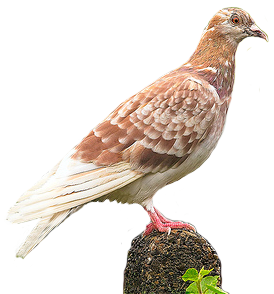
“All ferals are under intense selection pressure. The sad fact though is that there is almost no documentation of it because to most people human commensals aren't worth the time to study. Somehow, someway, ash-red seems to be under negative selection pressure in most city environments. It could be that reds don't shed their feathers as easily when a predator grabs them. It could be that ash-red birds in the nest don't grow or thrive as well on the food amounts available to ferals. It could be that they have more flight damage due to fraying than do wild-type (blue/black) birds and are thus at a competitive disadvantage in flying to food sources or surviving in winter or raining conditions than are wild-type birds. There is absolutely nothing causing evolution to "create" ash-red. It just happened. It was almost assuredly promulgated under human control rather than under natural control. There may well always have been and apparently is still continuing intense selection naturally against ash and only human love of it kept it going” (Frank Mosca, private communication).
I also believe that the ash-red mutation’s survival chances are low in the wild and they would not have breed in to domestic pigeons if humans did not recognize this odd color mutation and kept inbreeding them to their flocks. We have other dominant colors and patterns like almond, and grizzle also, but we don’t see them in the wild as much or take over a flock either. The variety of colors and patterns we see in domestic pigeons are considerably reduced in free-living feral pigeons. Wild rock-doves are mainly blue bar in color and pattern; therefore, we can presume plumage variation in domestic pigeons must have been the result of human preservation of plumage mutants by selective breeding. The reduction of color and pattern in feral pigeons are independent of human selective breeding which suggests that natural selection has reasserted itself. Consistent with such a suggestion, some of the colors and patterns of domestics come with survival disadvantages or reproductive penalties and are accordingly either favored or culled from pigeons living in the wild. This should be expected because ferals live under demanding wild conditions.
 Based
on “Selection of Traits” theory
by Charles Darwin, in order for existence, survival and reproduction
do not come down to pure chance, instead, if an animal has some trait
that helps it to withstand the environment better or breed more successfully,
it will leave more offspring behind than others. I believe this is
why in domesticated pigeons we have all the odd color mutations and
different
talents, where we don’t see these odd mutations in common flock of
feral pigeons. Fanciers played a big role on inbreeding
the odd birds and perfecting their color and pattern for the
last 4,000-5,000 years. I also think that mutations from wild-type
are not meant
to survive
for their selection of traits; otherwise these mutants would
have survived in the wild on their own and would not have been eliminated
by nature. Only the strongest and the
fittest would survive. This is why we have all the odd color mutations
and
different
talents in domestic pigeons and not in free-living common Columba livia.
Based
on “Selection of Traits” theory
by Charles Darwin, in order for existence, survival and reproduction
do not come down to pure chance, instead, if an animal has some trait
that helps it to withstand the environment better or breed more successfully,
it will leave more offspring behind than others. I believe this is
why in domesticated pigeons we have all the odd color mutations and
different
talents, where we don’t see these odd mutations in common flock of
feral pigeons. Fanciers played a big role on inbreeding
the odd birds and perfecting their color and pattern for the
last 4,000-5,000 years. I also think that mutations from wild-type
are not meant
to survive
for their selection of traits; otherwise these mutants would
have survived in the wild on their own and would not have been eliminated
by nature. Only the strongest and the
fittest would survive. This is why we have all the odd color mutations
and
different
talents in domestic pigeons and not in free-living common Columba livia.
Take albinism as an example, which is a recessive gene found in many living things. If we breed two humans together who are known to carry the albino trait we will make homozygous albinos. From those homozygous albinos we could create an albino family. The problem is we would create a family of albino people with eye problems and a lot of other health problems keeping them from enjoying life as much as a non albino. Nature would try not to allow this, unless we purposely keep inbreeding two albino individuals. I think the ash-red mutation and any other odd mutations in pigeons work in the same way. The only reason they exist in domestic pigeons is humans spared them and kept inbreeding them; these mutants would not have survived otherwise. Something in the wild is preventing ash-reds from taking over because nature does not select them even though it is a dominant mutation to wild-type.
The only mystery is what are the causes of this? What are the reasons preventing ash-reds, almonds, or any other mutations from taking over the feral flocks or at least reaching equilibrium? Mating two almond pigeons creates eye problems, and it is not recommended to mate almond pigeons together. Perhaps pigeons instinctively know an ash-red’s survival chances are low for some reason, and therefore choose not to breed with odd mutations like ash-red in the wild? Further research is needed to solve these mysteries...but I think the selection of traits as Darwin once described has a lot to do with odd mutations like ash-reds existing in the wild.
Copyright December, 2009 by Arif Mümtaz.